Introduction: The Landscape of WordPress SEO in 2026
The digital ecosystem has undergone a seismic shift as we enter 2026. Search engine optimization is no longer just about keyword density or backlink counts; it is about holistic user experience, semantic relevance, and AI-driven search intent. With the full integration of Search Generative Experience (SGE) into Google’s core algorithms, WordPress site owners must adapt to a world where search engines act as answer engines. This WordPress SEO Guide: Rank Higher on Google in 2026 provides a strategic roadmap for navigating these complexities, ensuring your website remains visible, authoritative, and conversion-ready.
In 2026, Google’s ranking factors prioritize Information Gain—the concept of providing unique value that doesn’t exist elsewhere on the web. As AI-generated content saturates the internet, human expertise and verified data have become the ultimate currency. To succeed, your WordPress site must be technically flawless, lightning-fast, and deeply integrated with structured data that helps AI models understand your content’s context.
1. The Foundation: Performance-First Hosting and Infrastructure
Before optimizing a single line of content, you must address the infrastructure. Google’s emphasis on Core Web Vitals has reached its peak, with Interaction to Next Paint (INP) now serving as a primary metric for user responsiveness. A slow host is a ranking death sentence.
High-Performance Managed WordPress Hosting
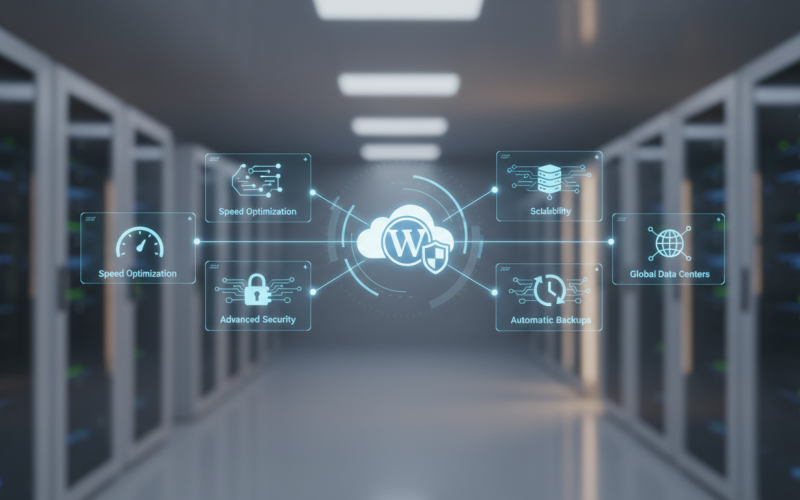
To rank higher, your hosting provider must support the latest server-side technologies, including PHP 8.4+, HTTP/3, and server-level caching. We recommend utilizing high-performance solutions like Sky Hostic to ensure your server response times (TTFB) remain under 200ms. Managed hosting environments specifically tuned for WordPress provide the necessary edge in stability and security that Google demands in 2026.
The Role of Edge Computing and CDNs
In 2026, a standard CDN is no longer enough. You need Edge SEO capabilities. This involves using platforms that allow you to execute code at the edge, optimizing images on the fly, and minifying scripts before they even reach the user’s browser. This reduces the load on your main server and ensures global users experience instantaneous page loads.
2. Technical SEO: Beyond the Basics
Technical SEO in 2026 is about making your site as machine-readable as possible while maintaining a seamless human experience. The divide between the two has narrowed significantly.
Advanced Schema Markup and Linked Data
Schema.org vocabulary has expanded. Your WordPress site should use JSON-LD to implement advanced schemas such as Speakable, FactCheck, and ProfilePage. For 2026, Entity Linking is crucial. This involves connecting your content to known entities in Google’s Knowledge Graph, helping the search engine understand that your brand is an authority in its specific niche.
Optimizing for Core Web Vitals (INP Focus)
While LCP (Largest Contentful Paint) and CLS (Cumulative Layout Shift) remain important, INP (Interaction to Next Paint) is the metric that defines 2026 SEO. It measures the latency of every user interaction. To optimize for INP on WordPress:
- Minimize main-thread work by deferring non-essential JavaScript.
- Use ‘yield to main’ strategies for complex scripts.
- Avoid heavy page builders that inject excessive DOM elements.
- Prioritize native WordPress blocks (Gutenberg) for leaner code.
3. Content Strategy: Navigating the AI-Search Era
Google’s SGE (Search Generative Experience) means that for many queries, the user never leaves the search results page. Your content must be designed to either be the source of that generative answer or provide such deep, unique value that users feel compelled to click through for the full experience.
The ‘Information Gain’ Model
In 2026, if your article says the same thing as the top 10 results, it will not rank. You must provide Information Gain. This is achieved by:
- Including original research and proprietary data.
- Providing expert interviews and unique perspectives.
- Using high-quality, original imagery and video instead of stock photos.
- Case studies that demonstrate real-world application of theories.
Semantic Content Optimization
Keywords are now entities. Instead of focusing on a single phrase, build content clusters around topics. Use tools to identify LSI (Latent Semantic Indexing) keywords and related entities that Google expects to see in a comprehensive guide. If you are writing about “WordPress SEO,” your content must naturally include related concepts like “canonical tags,” “XML sitemaps,” “REST API,” and “headless architecture.”
4. On-Page SEO Mastery in 2026
On-page optimization has evolved into a sophisticated exercise in user intent matching. Every element on your page must serve a dual purpose: informing the user and guiding the crawler.
Dynamic Title Tags and Meta Descriptions
While still important, Google often rewrites titles in 2026 to better match the user’s specific query. To maintain control, use Title Tag Templates that include dynamic variables like the current year or specific user locations. This increases Click-Through Rate (CTR), which remains a vital indirect ranking signal.
Header Hierarchy and Table of Contents
Structure your content with a logical H2-H4 hierarchy. In 2026, Google often uses ‘Fragement Indexing’ to pull specific sections of your page into the search results. A clear, jump-linked Table of Contents allows both users and bots to navigate long-form deep dives efficiently.
5. The Rise of E-E-A-T and Digital Authority
Experience, Expertise, Authoritativeness, and Trustworthiness (E-E-A-T) are the pillars of 2026 SEO. Google needs to know who is behind the content and why they should be trusted.
Author Entities and Social Proof
Every post on your WordPress site should be attributed to a verified author. This author should have a detailed bio page, links to social profiles, and Schema.org/Person markup. Google tracks authors as entities; if your authors are recognized experts in their field, your content will naturally rank higher.
Building Trust with Transparency
Include clear disclosure statements, privacy policies, and ‘About Us’ pages that detail your organization’s history. In an era of AI misinformation, being a ‘Verified Human’ source is a significant competitive advantage.
6. Mobile-First and Voice Search Optimization
With the proliferation of wearable tech and smart assistants, voice search has become a primary navigation method. Your WordPress SEO strategy must account for conversational queries.
- Natural Language Processing (NLP): Write in a way that answers questions directly. Use ‘Who, What, Where, Why, and How’ headers.
- Mobile Usability: Ensure your mobile site isn’t just a responsive version of the desktop, but a purpose-built experience with touch-friendly elements and readable font sizes (minimum 16px).
7. Security as a Ranking Factor
In 2026, security is no longer optional. Google penalizes sites that show any signs of vulnerability. WordPress, being the most popular CMS, is a frequent target. To protect your rankings:
- Implement Two-Factor Authentication (2FA) for all users.
- Use an Enterprise-Grade Firewall (WAF).
- Ensure your SSL certificate is properly configured with HSTS (HTTP Strict Transport Security) to prevent man-in-the-middle attacks.
- Regularly audit your plugins and remove any that are abandoned or have known vulnerabilities.
Frequently Asked Questions
What is the most important WordPress SEO factor in 2026?
User Intent and Information Gain. While technical SEO is the foundation, your ability to provide unique, expert-led content that answers a user’s query better than an AI-generated summary is the most critical factor for ranking.
Does the choice of WordPress theme affect SEO?
Yes, significantly. In 2026, themes that are bloated with CSS and JavaScript will hurt your INP scores. Choose lightweight themes like GeneratePress or Astra, or use the Block Editor (Gutenberg) to build custom, lean layouts.
How often should I update my old content?
Content decay is faster in 2026. You should audit and update your top-performing posts every 3-6 months to ensure data is current, links are active, and the content still meets the evolving search intent.
Are backlinks still relevant for WordPress SEO?
Yes, but quality has completely superseded quantity. A single link from a high-authority, niche-relevant site is worth more than thousands of low-quality directory links. Focus on ‘Digital PR’ and building genuine relationships.
Is AI-generated content bad for SEO?
Not inherently. Google rewards high-quality content regardless of how it’s produced. However, ‘raw’ AI content often lacks the E-E-A-T and Information Gain required to rank in 2026. Use AI for outlining and research, but ensure the final output is human-verified and enhanced.
Conclusion: Future-Proofing Your WordPress Site
Ranking higher on Google in 2026 requires a shift from ‘gaming the system’ to ‘serving the user.’ By focusing on high-performance infrastructure, deep technical optimization, and content that provides genuine value, you position your WordPress site as a leader in your industry. Remember that SEO is an iterative process. Stay informed on the latest algorithm updates, prioritize your site’s security and speed, and always put the user’s needs at the center of your digital strategy. The future of search belongs to those who provide the most reliable, accessible, and insightful information.