Introduction
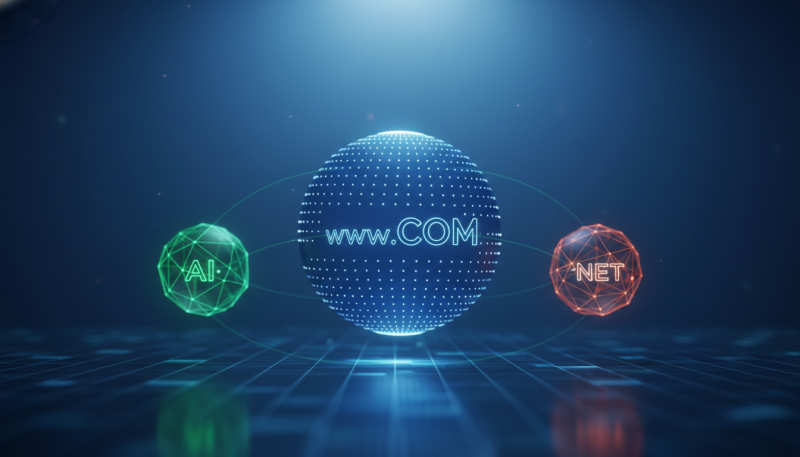
In the rapidly evolving digital landscape, your domain name is more than just a web address; it is the cornerstone of your online identity, a critical component of your branding strategy, and a significant factor in your search engine visibility. As we navigate through the current era of the internet, the choice of a Top-Level Domain (TLD) has become increasingly complex. Gone are the days when .com was the only viable option. Today, entrepreneurs, developers, and global corporations must choose between the legacy reliability of .com, the specialized tech-centric appeal of .ai, and the infrastructure-rooted history of .net. This article provides a comprehensive exploration of The Ultimate Guide to Domain Extensions (.com vs .ai vs .net), analyzing the technical, psychological, and SEO-related nuances of each to help you make an informed decision for your digital real estate.
The History and Evolution of Top-Level Domains (TLDs)
To understand the current state of domain extensions, we must first look at the history of the Domain Name System (DNS). Established in the mid-1980s, the DNS was designed to translate human-readable names into IP addresses. Initially, a handful of extensions were introduced, including .com (commercial), .net (network), .org (organization), .edu (education), and .gov (government). For decades, these ‘legacy’ TLDs dominated the web.
However, as the internet grew from a niche academic and military tool into a global marketplace, the demand for unique and memorable domain names skyrocketed. This led to the expansion of the TLD space by ICANN (Internet Corporation for Assigned Names and Numbers), introducing hundreds of new generic TLDs (gTLDs) and repurposing country-code TLDs (ccTLDs) for global use. The emergence of .ai is a prime example of this evolution, where a country-specific extension has been adopted by a global industry.
.com: The Undisputed Global Gold Standard
The .com extension is the most recognized and widely used TLD in the world. Originally intended for commercial entities, it has become the default extension for almost every type of website. When users think of a website, they instinctively add ‘.com’ to the end of the brand name. This psychological phenomenon is known as ‘domain bias,’ and it gives .com a significant advantage in terms of direct traffic and trust.
The Psychology of Trust and Credibility
From a consumer perspective, a .com domain signals longevity and stability. Because it was the first major extension, the general public perceives it as the most authoritative. For businesses, this translates into higher click-through rates (CTR) in search results and offline marketing. If a customer sees a brand advertised on a billboard, they are far more likely to remember the name if it ends in .com than if it uses a more obscure extension.
The Challenge of Availability
The primary drawback of the .com extension is its own success. With over 160 million .com domains registered, finding a short, memorable, and relevant name that isn’t already taken is a monumental task. This has given rise to a massive secondary market where premium .com domains are sold for thousands, or even millions, of dollars. For new startups, this often necessitates a trade-off: choose a longer, less ideal .com name or opt for a modern extension like .ai.
.ai: The Modern Frontier for Technology and Innovation
The .ai extension is technically a country-code TLD (ccTLD) assigned to Anguilla, a small British Overseas Territory in the Caribbean. However, due to the explosion of Artificial Intelligence, ICANN and Google now treat it as a generic TLD (gTLD) for SEO purposes. It has become the definitive choice for tech startups, machine learning platforms, and data science firms.
Why the Tech Industry Has Embraced .ai
In the world of technology, branding is about signaling innovation. Using a .ai extension immediately informs the visitor about the nature of the business. It suggests that the company is at the cutting edge of the Fourth Industrial Revolution. For investors and talent, a .ai domain acts as a badge of relevance. Furthermore, because it is more specialized, there is still a significant amount of high-quality inventory available compared to .com.
Pricing and Registration Considerations
It is important to note that .ai domains are significantly more expensive than .com or .net. While a .com might cost $10 to $15 per year, a .ai domain typically starts at $50 to $100 per year, often requiring a two-year minimum registration. This higher price point acts as a barrier to entry, which can actually help maintain the ‘premium’ feel of the extension by discouraging domain squatters.
.net: The Reliable Infrastructure Specialist
The .net extension stands for ‘network’ and was originally intended for internet service providers and infrastructure companies. While it has never reached the heights of .com, it remains the second most popular legacy extension and is widely respected in technical circles.
When to Choose .net Over .com
If your desired .com is unavailable and you are not specifically an AI-focused company, .net is often the most logical second choice. It is particularly effective for businesses involved in networking, database management, email hosting, or software-as-a-service (SaaS) platforms that provide the ‘backbone’ for other services. It carries a level of professional gravitas that newer, ‘trendy’ extensions often lack.
SEO and Perception of .net
From an SEO standpoint, .net is treated identically to .com by Google. The challenge lies in user perception. If a user is looking for your brand and types in .com by habit, they might end up on a competitor’s site or a ‘parked’ page. This is why many businesses that use .net eventually try to acquire the .com version of their name as they grow.
Comparative Analysis: .com vs .ai vs .net
Choosing between these three requires a strategic look at your business goals. Below is a breakdown of how they compare across key metrics:
- Memorability: .com is the clear winner. It is the default in the human brain. .ai is highly memorable within the tech niche, while .net is moderately memorable but often confused with .com.
- Availability: .ai offers the most creative freedom currently. .net is moderately available, and .com is extremely limited.
- Cost: .com and .net are budget-friendly. .ai is a premium-priced asset.
- SEO Impact: All three are equal in the eyes of search algorithms, but .com often has a slight edge in organic CTR due to user trust.
- Brand Identity: .ai screams ‘future’ and ‘tech.’ .com says ‘established’ and ‘global.’ .net says ‘technical’ and ‘functional.’
The Impact of Domain Extensions on SEO
A common misconception in the digital marketing world is that your domain extension is a primary ranking factor. Google has stated multiple times that the TLD itself does not give you an automatic boost in rankings. However, the indirect effects on SEO are profound. The Ultimate Guide to Domain Extensions (.com vs .ai vs .net) must emphasize that SEO is about more than just algorithms; it is about user behavior.
If two identical sites are competing in search results—one with a .com and one with a .xyz extension—the .com is likely to receive more clicks because users trust it more. Higher CTR is a positive signal to search engines, which can lead to higher rankings over time. Furthermore, backlinks are the currency of the web. Webmasters are more likely to link to a site that looks professional and established. A .com or a highly relevant .ai domain often facilitates easier link-building than a generic or spammy-looking extension.
Technical Management and Hosting Integration
Once you have selected your domain extension, the next step is ensuring it is supported by a robust hosting environment. Not all registrars and hosting providers handle every extension with the same level of expertise. When you are ready to launch your project, choosing a reliable partner like Sky Hostic ensures your domain is backed by high-performance infrastructure, secure DNS management, and seamless integration between your TLD and your web server.
Technical considerations such as DNSSEC (Domain Name System Security Extensions) are also vital. For a .ai domain, which is often used by tech companies handling sensitive data, ensuring your registrar supports advanced security protocols is non-negotiable. Similarly, the speed of your DNS propagation can vary depending on the TLD’s registry management, making a high-quality hosting provider essential for maintaining uptime.
Frequently Asked Questions
1. Does using a .ai domain hurt my SEO if I’m not in Anguilla?
No. While .ai is technically a country-code TLD for Anguilla, Google treats it as a generic TLD (gTLD). This means it has the same global ranking potential as a .com or .net, regardless of your physical location.
2. Is .net better than .com for technical websites?
Not necessarily. While .net was originally for network-based companies, .com is still the preferred choice for almost all commercial ventures. However, .net is a very strong and respected alternative if the .com is unavailable.
3. Why are .ai domains so much more expensive?
The government of Anguilla sets the wholesale price for .ai domains. Because of the high demand from the global tech industry, they have positioned it as a premium extension, which also helps fund the island’s infrastructure.
4. Can I change my domain extension later?
Yes, but it is a complex process. You would need to perform a 301 redirect from the old domain to the new one. This can result in a temporary drop in SEO rankings and can be confusing for your existing customers, so it is best to choose the right extension from the start.
5. Should I buy multiple extensions for my brand?
Yes. It is a common ‘brand protection’ strategy to buy the .com, .net, and .ai versions of your name. This prevents competitors or ‘cybersquatters’ from owning them and allows you to redirect all of them to your primary website.
Conclusion
Choosing the right domain extension is a foundational decision that will impact your business for years to come. The .com extension remains the gold standard for general business, offering unmatched trust and memorability. For those in the technology and artificial intelligence sectors, .ai provides a powerful branding opportunity that signals innovation and industry leadership. Meanwhile, .net serves as a reliable, professional alternative for infrastructure and network-related services. By understanding the strengths and weaknesses of each, and ensuring your domain is supported by a top-tier provider like Sky Hostic, you can build a digital presence that is both authoritative and future-proof. Whether you prioritize the legacy of .com, the innovation of .ai, or the reliability of .net, your choice should align with your long-term brand vision and the expectations of your target audience.