Introduction
In the rapidly evolving digital landscape of 2024 and beyond, the foundation of any successful online venture is its web hosting infrastructure. As businesses transition from simple digital brochures to complex, high-traffic web applications, the question of infrastructure becomes paramount. Choosing between Shared, VPS, and Dedicated hosting is one of the most critical decisions a webmaster or business owner will make. This choice dictates not only the performance and speed of a website but also its security posture, scalability potential, and overall cost-efficiency. The hosting industry has seen a massive shift toward virtualization and cloud-integrated solutions, yet the core distinctions between these three primary hosting categories remain the benchmark for decision-making. In this comprehensive guide, we will perform a deep-dive analysis into Shared vs VPS vs Dedicated Hosting: Which One Should You Choose? We will explore the technical nuances, resource allocations, and strategic advantages of each to ensure you make an informed choice that aligns with your long-term growth objectives.
Understanding Shared Hosting: The Entry-Level Standard
What is Shared Hosting?
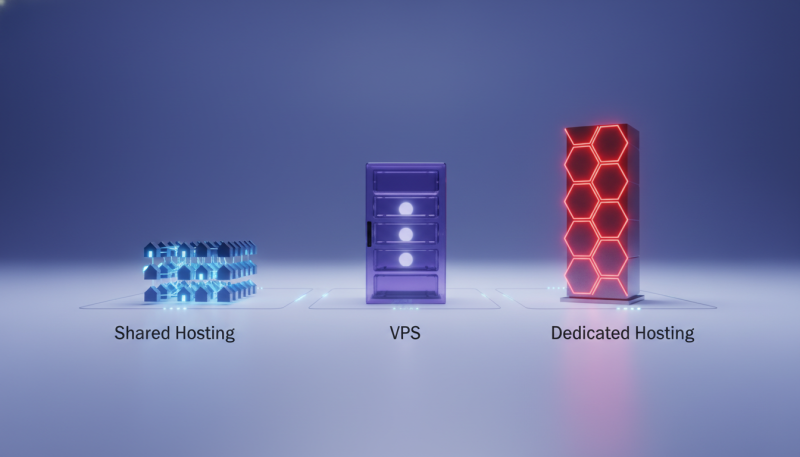
Shared hosting is the most common entry point for individuals and small businesses entering the digital space. In a shared environment, multiple websites are hosted on a single physical server. These websites all share the same pool of server resources, including Central Processing Unit (CPU) time, Random Access Memory (RAM), and disk space. Think of shared hosting like living in an apartment building; while you have your own private space (your website files), you share the building’s infrastructure, such as the plumbing, electricity, and common areas, with many other tenants.
The Technical Realities of Resource Contention
Because resources are shared, the performance of your website can be influenced by the activity of other websites on the same server. This is often referred to as the “noisy neighbor” effect. If one website experiences a sudden surge in traffic or runs a poorly optimized script that consumes excessive CPU cycles, other sites on the server may experience latency or downtime. Modern hosting providers use advanced resource management tools like CloudLinux to mitigate this, but the fundamental limitation of resource contention remains a core characteristic of shared hosting.
Pros and Cons of Shared Hosting
Pros: The primary advantage is cost. Because the provider splits the server maintenance costs among hundreds or thousands of users, the price is extremely low. Additionally, shared hosting is fully managed, meaning the host handles all server-side configurations, security patches, and software updates. It is designed for ease of use, often featuring one-click installers for platforms like WordPress.
Cons: The limitations include restricted access to server configurations, lower performance ceilings, and potential security risks if the server is not properly isolated. You cannot install custom software or change deep-level server settings, which can be a deal-breaker for developers.
VPS Hosting: The Balanced Middle Ground
What is VPS Hosting?
Virtual Private Server (VPS) hosting represents a significant step up from shared hosting. While you are still sharing a physical server with other users, the technology used is fundamentally different. VPS hosting utilizes a technology called virtualization (via a hypervisor) to divide a physical server into several virtual servers. Each virtual server acts as a completely independent unit with its own dedicated slice of the server’s resources. If we use the housing analogy again, a VPS is like owning a townhouse or a condo. You still share the land, but you have your own dedicated systems and more control over your specific unit.
The Power of Virtualization and Isolation
The key benefit of VPS hosting is isolation. In a VPS environment, your allocated RAM and CPU are guaranteed. If you have 8GB of RAM assigned to your VPS, that memory is yours regardless of what other users on the physical machine are doing. This eliminates the “noisy neighbor” effect found in shared hosting. Furthermore, VPS hosting provides “Root Access,” allowing you to choose your Operating System (OS), install custom applications, and modify the server configuration at the kernel level.
Scalability and Flexibility
VPS hosting is highly scalable. Because the environment is virtualized, increasing your resources is often as simple as a few clicks in a dashboard. You can scale your RAM or CPU cores instantly to handle seasonal traffic spikes without the need to migrate your data to a new physical machine. This makes it an ideal choice for growing e-commerce stores and membership sites that require consistent performance but aren’t yet ready for the cost of a dedicated server.
Dedicated Hosting: The Ultimate Powerhouse
What is Dedicated Hosting?
Dedicated hosting is exactly what it sounds like: you rent an entire physical server exclusively for your website or application. There are no other tenants, no shared resources, and no virtualization layers unless you choose to install them yourself. This is the equivalent of owning a large, private estate. You have total control over every aspect of the hardware and software.
Unmatched Performance and Customization
With a dedicated server, every bit of the hardware’s power is at your disposal. This is essential for high-traffic websites, large-scale databases, or applications that require intense computational power. You can specify the exact hardware components you need, such as NVMe SSDs for lightning-fast data retrieval, high-core-count processors, and massive amounts of Error-Correcting Code (ECC) RAM. This level of customization ensures that the server is perfectly tuned to your specific workload requirements.
Security and Compliance
For enterprises handling sensitive data, such as medical records or financial transactions, dedicated hosting is often a requirement for compliance (like HIPAA or PCI-DSS). Since you are the only user on the hardware, the risk of cross-site contamination or data leaks via shared infrastructure is virtually eliminated. You can implement bespoke security protocols, hardware firewalls, and intrusion detection systems that would be impossible in a shared or even some VPS environments.
Comparative Analysis: Performance, Security, and Cost
Performance Benchmarking
When comparing Shared vs VPS vs Dedicated Hosting: Which One Should You Choose? based on performance, the hierarchy is clear. Shared hosting is suitable for low-traffic blogs (under 10,000 visitors per month). VPS hosting can comfortably handle 50,000 to 200,000 visitors depending on optimization. Dedicated hosting is the only viable option for sites receiving millions of hits or those requiring sub-second database response times for complex queries.
Security Architectures
Security is a layered concept. In shared hosting, you rely entirely on the provider’s security. In a VPS, you have a private environment, but the hypervisor itself could theoretically be a point of failure (though rare). Dedicated hosting provides the highest physical and logical isolation. If your business model relies on high trust and data integrity, moving toward a VPS or Dedicated solution is a mandatory step.
The Cost-Benefit Ratio
Shared hosting is a commodity, often costing less than a cup of coffee per month. VPS hosting ranges from $20 to $100 per month, offering the best value for most professional sites. Dedicated hosting is a significant investment, often starting at $100 and going up to several thousand dollars per month. The choice depends on whether the revenue generated by the site justifies the infrastructure cost. For high-performance needs, Sky Hostic offers a range of scalable solutions that bridge the gap between these tiers, providing reliable infrastructure for any stage of business growth.
How to Choose: The Decision Matrix
Assess Your Traffic Volume
The most immediate metric is your traffic. If you are just starting, shared hosting is sufficient. However, if you see consistent growth or plan a major marketing campaign, a VPS is the safer bet to avoid crashes. If you are a global brand with massive concurrent users, a dedicated server is non-negotiable.
Technical Expertise
Shared hosting requires zero technical skill. Managed VPS hosting is also very user-friendly. However, unmanaged VPS and Dedicated hosting require a deep understanding of Linux/Windows server administration, command-line interfaces, and security hardening. If you do not have a sysadmin on staff, always opt for managed services.
Budgetary Constraints
Don’t overbuy. While a dedicated server is powerful, it is overkill for a small WordPress blog. Start with what you need and scale up. The beauty of modern hosting is the ability to migrate as your requirements evolve.
Frequently Asked Questions
1. Can I upgrade from shared to VPS later?
Yes, most reputable hosts make this process seamless. They can migrate your files and databases to a VPS environment with minimal downtime, usually within a few hours.
2. Is VPS hosting better for SEO?
Indirectly, yes. Site speed is a confirmed ranking factor for Google. Because VPS hosting typically offers faster load times and better stability than shared hosting, it can contribute to better search engine rankings.
3. Do I need a dedicated server for an e-commerce site?
Not necessarily. A well-configured VPS is often enough for small to medium e-commerce stores. However, once you handle thousands of transactions daily, a dedicated server provides the stability and security required for high-volume processing.
4. What is the difference between managed and unmanaged hosting?
Managed hosting means the provider handles the technical aspects of the server (updates, backups, security). Unmanaged means you get the hardware and an OS, and everything else is your responsibility.
5. Is dedicated hosting more secure than the cloud?
Dedicated hosting offers physical isolation, which some consider more secure for specific compliance needs. However, modern cloud/VPS solutions are extremely secure and offer better redundancy in some cases.
Conclusion
Choosing between Shared vs VPS vs Dedicated Hosting: Which One Should You Choose? ultimately comes down to a balance of three factors: performance requirements, technical capability, and budget. Shared hosting is the perfect sandbox for beginners and low-traffic sites. VPS hosting is the “sweet spot” for growing businesses, offering the control and power of a dedicated environment at a fraction of the cost. Dedicated hosting remains the gold standard for enterprise-level applications where performance and security cannot be compromised. By carefully auditing your current needs and projecting your future growth, you can select a hosting path that ensures your website remains fast, secure, and accessible to your audience. Remember that your hosting is the silent partner in your online success; invest wisely to build a robust digital presence.