Introduction
In the current technological landscape, cloud computing has transitioned from a competitive advantage to a fundamental necessity for business operations. As of 2024, global enterprise spending on cloud infrastructure services continues to grow at an unprecedented rate, with organizations migrating legacy systems to more agile, scalable environments. However, the move to the cloud is not a monolithic transition. The primary challenge facing CTOs and IT decision-makers is determining which deployment model aligns with their specific operational requirements, security mandates, and budgetary constraints. Understanding the nuances between Public vs Private vs Hybrid Cloud is critical for optimizing performance and ensuring long-term sustainability.
The evolution of cloud computing has been driven by the need for on-demand resource availability without the overhead of physical hardware management. Industry trends indicate a significant shift toward multi-cloud and hybrid strategies as businesses seek to avoid vendor lock-in while maintaining strict data sovereignty. This article provides a comprehensive deep-dive into the three primary cloud models, offering a technical and strategic analysis to guide your infrastructure decisions.
What is Public Cloud?
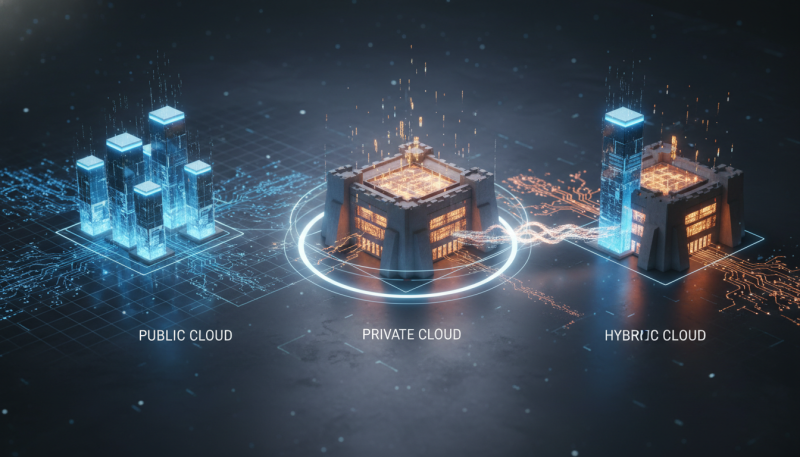
The public cloud is the most common form of cloud computing. In this model, cloud resources (such as servers and storage) are owned and operated by a third-party cloud service provider and delivered over the internet. In a public cloud, all hardware, software, and other supporting infrastructure are owned and managed by the cloud provider. You share the same hardware, storage, and network devices with other organizations, often referred to as cloud “tenants.”
Key Characteristics of Public Cloud
- Multi-tenancy: Multiple users share the same physical infrastructure, though their data and workloads are logically isolated.
- Elasticity: The ability to scale resources up or down almost instantaneously based on demand.
- Pay-as-you-go Pricing: Users typically pay only for the resources they consume, shifting costs from Capital Expenditure (CAPEX) to Operational Expenditure (OPEX).
- Global Reach: Providers like AWS, Microsoft Azure, and Google Cloud Platform (GCP) have data centers worldwide, allowing for low-latency access across the globe.
Advantages of Public Cloud
The primary benefit of the public cloud is its scalability. For businesses with fluctuating workloads, the public cloud offers the ability to handle traffic spikes without manual intervention. Additionally, the lack of maintenance responsibility is a significant draw; the provider handles all updates, security patches, and hardware refreshes. This allows internal IT teams to focus on core business logic rather than infrastructure maintenance.
Disadvantages of Public Cloud
Despite its popularity, the public cloud is not without drawbacks. The most cited concern is security and compliance. While public cloud providers invest billions in security, the shared responsibility model means that the user is still responsible for securing their data and applications. Furthermore, for highly regulated industries like finance or healthcare, the lack of control over the physical location of data can pose compliance challenges. Lastly, while the entry cost is low, unmonitored usage can lead to “cloud sprawl” and unexpectedly high monthly invoices.
What is Private Cloud?
A private cloud consists of cloud computing resources used exclusively by one business or organization. The private cloud can be physically located at your organization’s on-site data center, or it can be hosted by a third-party service provider. In a private cloud, the services and infrastructure are always maintained on a private network and the hardware and software are dedicated solely to your organization.
Key Characteristics of Private Cloud
- Single-tenancy: Resources are dedicated to a single organization, ensuring no resource contention with other users.
- Enhanced Security: Since the infrastructure is isolated, organizations have granular control over security protocols and hardware-level configurations.
- Predictable Performance: Without the “noisy neighbor” effect common in public clouds, performance remains consistent and predictable.
- Customization: Organizations can tailor the environment to meet specific technical requirements that public providers might not support.
Advantages of Private Cloud
The private cloud is the gold standard for security and control. It is ideal for organizations with strict data privacy requirements or those that must comply with rigid regulatory frameworks. Because the organization owns or has exclusive access to the hardware, they can implement custom security measures and ensure that data never leaves a specific geographic boundary. It also provides more predictable long-term costs for stable, high-intensity workloads that would be expensive to run in a public environment.
Disadvantages of Private Cloud
The main disadvantage is the high initial cost. Building an on-premise private cloud requires significant investment in hardware, networking, and expert staff to manage the environment. Even if hosted by a provider, the costs are generally higher than public cloud alternatives. Additionally, private clouds are less flexible; scaling up requires purchasing and installing new physical servers, which can take weeks or months compared to the minutes required in a public cloud.
What is Hybrid Cloud?
The hybrid cloud is often described as the “best of both worlds.” It is a computing environment that combines a public cloud and a private cloud by allowing data and applications to be shared between them. When computing and processing demand fluctuates, hybrid cloud computing gives businesses the ability to seamlessly scale their on-premises infrastructure up to the public cloud to handle any overflow—without giving third-party data centers access to the entirety of their data.
How Hybrid Cloud Works
Hybrid cloud integration is achieved through encrypted connections or dedicated private lines (like AWS Direct Connect or Azure ExpressRoute). This allows for Cloud Bursting, where an application runs in a private cloud or data center and “bursts” into a public cloud when the demand for computing capacity spikes. This ensures that the organization only pays for extra computing power when it is absolutely necessary.
Advantages of Hybrid Cloud
- Flexibility: Move workloads between environments based on cost, security needs, or performance requirements.
- Cost Management: Keep sensitive data on cheaper, long-term private storage while using public cloud for high-compute tasks.
- Gradual Migration: Organizations can migrate to the cloud at their own pace, moving non-critical workloads first while keeping legacy systems on-premise.
Disadvantages of Hybrid Cloud
The primary challenge of a hybrid cloud is complexity. Managing two different environments requires a unified management platform and a highly skilled IT team. There are also potential integration hurdles; ensuring that applications can communicate seamlessly across different architectures can be difficult. Monitoring security across both environments also adds a layer of administrative overhead.
Public vs Private vs Hybrid: A Comparative Deep-Dive
Choosing between these models requires a balanced analysis of several factors. If your priority is speed to market and low upfront costs, the public cloud is the clear winner. For maximum security and regulatory compliance, the private cloud is unmatched. However, most modern enterprises find that the hybrid cloud offers the strategic balance necessary to remain competitive.
When evaluating these models, consider the Data Gravity of your applications. Applications that generate massive amounts of data may be cheaper to host in a private cloud to avoid high egress fees charged by public providers. Conversely, applications that require advanced AI or machine learning tools may benefit from the native services offered by public cloud ecosystems.
Choosing the Right Model for Your Business
To make the right choice, start by auditing your current workloads. Categorize them based on their sensitivity, performance requirements, and scalability needs. For many small to medium-sized businesses, starting with a managed solution is the most efficient path. Providers like Sky Hostic offer tailored infrastructure solutions that help bridge the gap between complex cloud architectures and business goals, ensuring that your transition to the cloud is both secure and cost-effective.
Frequently Asked Questions
1. Which cloud model is the most secure?
The private cloud is generally considered the most secure because it offers dedicated resources and total control over the environment. However, public clouds offer high-level security features that are often more advanced than what a small company could implement on its own.
2. Is public cloud always cheaper than private cloud?
Not necessarily. While public cloud has lower upfront costs, for large, steady-state workloads, a private cloud can be more cost-effective over a 3-5 year period by eliminating monthly subscription and data egress fees.
3. What is ‘Cloud Bursting’?
Cloud bursting is a configuration in hybrid clouds where an application runs in a private cloud but uses public cloud resources to handle peaks in IT demand.
4. Can I switch from one model to another later?
Yes, but it can be complex. Moving from public to private (repatriation) or vice versa requires significant planning regarding data migration, application refactoring, and networking.
5. What industries prefer hybrid cloud?
Industries like finance, healthcare, and government often prefer hybrid cloud because they can keep sensitive data in a private environment while using the public cloud for less sensitive administrative tasks.
Conclusion
The debate of Public vs Private vs Hybrid Cloud does not have a one-size-fits-all answer. Each model offers distinct advantages tailored to different business needs. The public cloud provides unparalleled agility, the private cloud offers uncompromising control, and the hybrid cloud provides a versatile middle ground. As the digital economy evolves, the ability to leverage the right infrastructure at the right time will define the success of modern enterprises. By understanding these fundamental differences, you can build a robust, scalable, and secure foundation for your organization’s future.