Introduction
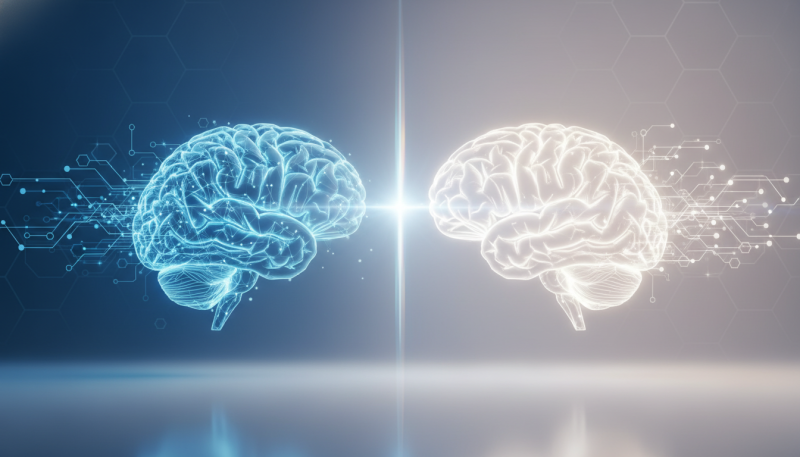
The discourse surrounding AI vs Human Intelligence: What the Future Holds has transitioned from the realms of science fiction into the core of global strategic planning. As we navigate the third decade of the 21st century, the acceleration of Large Language Models (LLMs), generative neural networks, and specialized machine learning algorithms has forced a re-evaluation of what it means to be ‘intelligent.’ We are currently witnessing a paradigm shift where the boundaries between biological cognition and synthetic computation are blurring. Industry trends suggest that by 2030, AI integration will contribute trillions to the global economy, yet the fundamental differences between human neurobiology and silicon-based logic remain profound. This article provides a comprehensive deep-dive into the structural, functional, and ethical dimensions of this technological rivalry and partnership.
The Fundamental Nature of Intelligence
To understand the future, we must first define the playing field. Human intelligence is a multifaceted phenomenon characterized by self-awareness, emotional depth, abstract reasoning, and the ability to apply knowledge across disparate contexts. It is rooted in millions of years of evolution, designed primarily for survival, social cohesion, and complex problem-solving in unpredictable environments.
Computational Logic vs. Cognitive Intuition
AI intelligence, by contrast, is currently ‘narrow.’ It excels at processing vast datasets, identifying patterns, and executing specific tasks with a level of precision and speed that no human can match. However, AI lacks ‘intuition’ in the biological sense. While a human can make a decision based on a ‘gut feeling’—which is actually the brain’s rapid synthesis of lifetime experiences—an AI relies on probabilistic outcomes derived from its training data. The future of this relationship hinges on whether AI can move beyond being a ‘stochastic parrot’ to a system capable of genuine understanding.
Structural Disparities: Silicon vs. Synapses
The architecture of the human brain is often compared to a computer, but this is a significant oversimplification. The human brain contains approximately 86 billion neurons, interconnected by trillions of synapses. It operates on a massively parallel scale with incredible energy efficiency, consuming roughly 20 watts of power—less than a standard light bulb.
Processing Speed and Data Throughput
In terms of raw speed, silicon-based systems are the clear winners. A modern CPU can perform billions of operations per second, whereas human neuronal firing is limited to about 200 Hz. This allows AI to analyze the entire medical literature of the last 50 years in seconds to suggest a diagnosis, a feat impossible for any human team. As businesses scale these computational needs, high-performance infrastructure provided by Sky Hostic becomes the backbone for hosting the complex environments required to train and deploy these models effectively.
Energy Efficiency and Biological Optimization
Despite the speed of AI, the carbon footprint of training a single large-scale model can be equivalent to the lifetime emissions of multiple automobiles. Humans, however, learn through ‘few-shot’ or even ‘one-shot’ learning. A child only needs to see a cat once or twice to recognize all cats in the future. Current AI models require millions of labeled images to achieve similar accuracy. The future of AI development is currently focused on ‘neuromorphic computing’—designing hardware that mimics the brain’s efficiency.
The Evolution of Artificial General Intelligence (AGI)
The holy grail of the tech industry is Artificial General Intelligence (AGI)—a machine that can perform any intellectual task a human can. We are currently in the era of Artificial Narrow Intelligence (ANI). The transition to AGI represents a ‘singularity’ point. Experts are divided on the timeline; some predict AGI by 2029, while others believe it remains centuries away. The leap to AGI requires the machine to possess ‘common sense’ and ‘transfer learning’ capabilities, allowing it to take what it learned in one domain (like chess) and apply it to another (like diplomatic negotiation).
Collaborative Intelligence: The Human-AI Hybrid
Rather than a zero-sum game, the most likely future is one of ‘Centaur Intelligence.’ This term, originating from the world of chess, refers to a human and an AI working together to achieve results superior to what either could achieve alone. In medicine, AI can identify microscopic anomalies in scans while the human doctor provides the empathetic communication and ethical judgment necessary for patient care. In creative fields, AI serves as a sophisticated brush, but the human artist provides the intent and the ‘soul’ of the work.
Socio-Economic Implications of the AI Revolution
The impact on the labor market is a primary concern for policymakers. While AI will undoubtedly automate routine tasks—both manual and cognitive—it is also creating entirely new categories of work. Roles such as ‘Prompt Engineers,’ ‘AI Ethicists,’ and ‘Data Curators’ did not exist a decade ago. The challenge lies in the speed of the transition. Unlike the Industrial Revolution, which spanned generations, the AI revolution is moving at a pace that threatens to outstrip the ability of educational systems to retrain the workforce.
Ethical Frontiers and the Alignment Challenge
The ‘Alignment Problem’ refers to the difficulty of ensuring that an AI’s goals are perfectly synchronized with human values. As AI systems become more autonomous, the risk of ‘instrumental convergence’—where an AI pursues a goal in a way that inadvertently harms humans—becomes a theoretical and practical reality. Furthermore, algorithmic bias remains a critical issue; AI systems trained on biased historical data can perpetuate and even amplify systemic inequalities in hiring, lending, and law enforcement.
Frequently Asked Questions
Can AI replace human creativity?
AI can generate content that appears creative by recombining existing patterns, but it lacks the lived experience, emotional resonance, and intentionality that define human art. It is a tool for creativity, not a replacement for the creator.
What is the biggest limitation of current AI?
The lack of true ‘understanding’ or consciousness. Current AI operates on statistical probability and does not have a conceptual model of the world, making it prone to ‘hallucinations’ or confident errors.
Will AI ever achieve consciousness?
This is a philosophical question as much as a technical one. While AI can simulate the appearance of consciousness, there is no scientific consensus on whether silicon-based systems can ever experience subjective reality (qualia).
How can professionals prepare for an AI-driven future?
The key is ‘upskilling’ in areas where humans retain a competitive advantage: emotional intelligence, complex strategy, ethical judgment, and interdisciplinary synthesis. Learning to work alongside AI tools is now a fundamental literacy.
What is the role of infrastructure in AI development?
AI development requires massive computational power and reliable uptime. Robust hosting and cloud infrastructure are essential for the iterative testing and deployment of machine learning models at scale.
Conclusion
The future of AI vs Human Intelligence is not a battle for dominance, but a journey toward integration. While AI offers unprecedented computational power and the ability to solve some of humanity’s most complex challenges—from climate change to protein folding—it remains a reflection of our own data and biases. Human intelligence, with its capacity for empathy, ethics, and abstract wonder, remains the guiding force. As we move forward, the focus must remain on building transparent, ethical, and aligned systems that augment human potential rather than diminish it. The synergy between biological and synthetic minds represents the next great chapter in human evolution.